
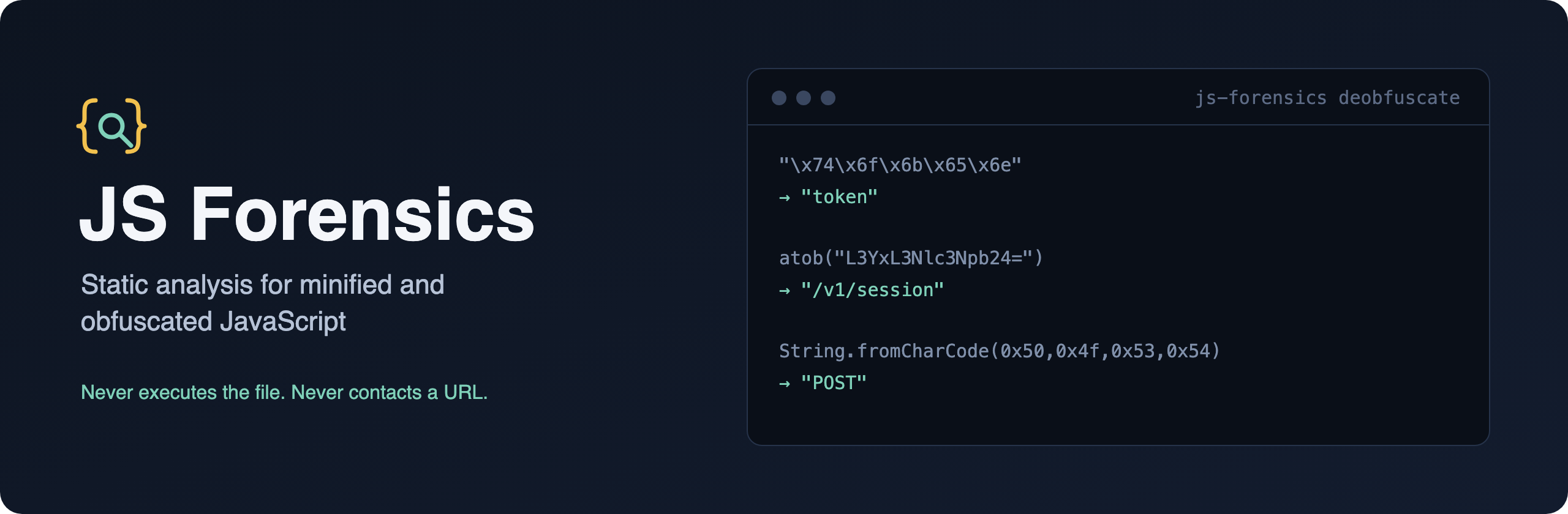
JS Forensics is a static-analysis toolkit for JavaScript that is minified, obfuscated, or simply unfamiliar. It parses a file, reports what is in it, and applies a small set of safe, traceable clean-up transformations.
It never executes the file it analyzes and never contacts a URL it finds.
Status: v0.1.0, alpha. The analyses are heuristic and the transformations are deliberately conservative. See Known limitations before relying on a result.
- Parses modern JavaScript with tree-sitter and reports syntax errors with line and column.
- Counts functions, declarations, identifiers, literals, calls, loops, and conditionals from the syntax tree.
- Detects twelve documented obfuscation indicators and shows the evidence for each one.
- Extracts string literals and sorts them into URLs, domains, API paths, HTTP header names, cookie strings, HTML, JSON, and everything else.
- Decodes escape-heavy literals and constant
String.fromCharCode,String.fromCodePoint, andatobcalls without running them. - Folds constant expressions such as
"a" + "b",0x3e8 * 0x3c, and!0. - Reports hex-style (
_0x1a2b) and very short identifier names. - Lists references to browser APIs (cookies, storage, network, canvas, WebGL, audio, WebRTC) and whether each is read, written, called, or constructed.
- Lists potential network endpoints with the HTTP method when the source determines it.
- Writes a terminal summary, JSON, or a standalone HTML report.
Python 3.10 to 3.14 is supported.
$ pip install js-forensics
$ js-forensics --version
js-forensics 0.1.0
To install from source instead:
$ git clone https://github.com/stackadnan/js-forensics.git
$ cd js-forensics
$ python -m venv .venv && source .venv/bin/activate
$ pip install .
The Quick start examples use examples/sample.js from the repository.
The repository ships a small obfuscated file to try things on.
$ js-forensics analyze examples/sample.js
$ js-forensics analyze examples/sample.js --format json --output report.json
$ js-forensics strings examples/sample.js
$ js-forensics endpoints examples/sample.js
$ js-forensics deobfuscate examples/sample.js --output-dir output/
$ js-forensics report examples/sample.js --format html --output report.html
analyze prints a summary. Part of the output for the sample:
Obfuscation indicators (heuristic score 45/100)
The score adds fixed weights for the indicators below. It is not a probability and not a verdict on
what the code does.
[+15] Escape-encoded string literals
    -  4 of 8 string literals spell printable ASCII text with \x or \u escapes.
    1:109  Escape-encoded literal.  "\x74\x6f\x6b\x65\x6e"
[+15] Hex-style identifier names
    -  6 of 6 declared names look like _0x1a2b.
[+10] Decoder calls with constant arguments
    1:167  atob call with constant arguments.  atob("L3YxL3Nlc3Npb24=")
[+5] Minified layout

Decoded values
Technique            At     Value
escape-sequences     1:14   https://api.example.com
escape-sequences     1:109  token
atob                 1:167  /v1/session
String.fromCharCode  1:271  POST

Browser APIs referenced
API    Category  Usage  Count  Confidence  First at
fetch  network   call   1      high        1:335

Potential network endpoints
Method   URL                      Source               Resolved  At
UNKNOWN  /v1/session              constant-expression  static    1:167
UNKNOWN  https://api.example.com  string-literal       static    1:14

Unresolved call  At     Reason
fetch            1:335  the URL argument is not a static string
deobfuscate turns the one-line sample into this, and records every change in
output/transformations.json:
var _0x3e1f=["https://api.example.com","token"];
function _0x2b7c(_0x1d){
  var _0x4a="/v1/session";
  if(true){
    return _0x3e1f[0x0]+_0x4a+"?"+_0x3e1f[0x1]+"="+_0x1d
  }
  return false
}
var _0x51="POST",_0x77=60000;
fetch(_0x2b7c("abc"),{method:_0x51,keepalive:!![]});
setTimeout(function(){
  console["log"]("done",_0x77)
},1000);
The names stay as they were and the array lookups are not inlined. That is the current boundary of what the tool does, not an oversight.
| Command | Purpose |
|---|---|
analyze FILE |
Summary of everything below. --format text|json. |
strings FILE |
String and template literals with categories. --category filters. |
endpoints FILE |
Potential network endpoints, domains, and request calls whose URL is dynamic. |
deobfuscate FILE |
Run the transformation pipeline. Writes to --output-dir (default js-forensics-output/). |
report FILE |
Standalone report. --format html|json; --transformations adds the pipeline history. |
Options shared by the analysis commands: --output/-o, --tolerant (analyze
a file despite syntax errors and mark the results as partial), --no-redact,
and --max-bytes (default 2 MiB).
Exit codes: 0 success, 2 invalid command line, 3 input file missing,
unreadable, too large, or not UTF-8, 4 JavaScript syntax error, 5 output
could not be written. 1 is an unexpected internal error.
docs/usage.md is the full reference, including the counting rules and every indicator's threshold. docs/output-schema.md describes the JSON.
| Area | How it works |
|---|---|
| Statistics | Counts of syntax-node types. No regular expressions over source text. |
| Obfuscation indicators | Twelve structural rules with fixed thresholds and weights. The score is the capped sum of the weights that triggered. |
| String classification | Pattern heuristics. One category per string; ambiguous strings stay other. |
| Static decoding | Reimplementations of JavaScript string escapes, String.fromCharCode, String.fromCodePoint, and atob, applied only to constant arguments. |
| Constant folding | A static evaluator for strings, numbers, and booleans covering arithmetic, bitwise, comparison of same-typed values, !, and string concatenation. |
| Browser APIs | A catalogue of global names and member chains, plus a few distinctive method names matched with lower confidence. |
| Endpoints | Arguments of fetch, XMLHttpRequest.open, WebSocket, EventSource, navigator.sendBeacon, axios, and $.ajax/$.get/$.post, plus URL-like string literals and constant expressions. |
Four stages run in order, each on the output of the one before:
format-statementsputs each statement on its own line. It only changes whitespace between statements.simplify-string-escapesrewrites"\x68\x69"as"hi".decode-static-callsreplaces decoder calls on constants with the string they return.fold-constantsreplaces constant operator expressions with their value.
Transformations edit exact source ranges; the program is not regenerated from
its syntax tree, so untouched code stays byte-for-byte as it was. After every
stage the result is parsed again, and a stage whose output does not parse is
discarded and reported as reverted. Each stage's output is saved under
stages/ so you can diff them.
An expression that cannot be resolved safely is left unchanged. Decoder calls
and all-constant expressions that were skipped are listed with the reason, for
example 1 / 0 ("/ by zero yields Infinity or NaN").
Every input is treated as hostile.
- The analyzed file is read and parsed. It is never evaluated, imported, or passed to a JavaScript runtime.
- No network access happens. URLs are extracted as text and nothing is resolved or fetched. The test suite fails if a socket is opened.
- The original file is never modified. Outputs go to a separate path and a write that would land on the input is refused.
- Input size is limited (2 MiB by default), nesting depth is bounded in the evaluator, and a transformation that would grow a file more than fourfold is reverted.
- HTML reports contain no script, carry a
default-src 'none'Content-Security-Policy, and escape all text taken from the file. Extracted URLs are shown as text, not links. - Terminal and HTML output escape control characters, so a file cannot inject ANSI sequences or bidirectional overrides into what you read.
- Likely credentials (JWTs, common API-key formats, bearer tokens, URL
passwords, secret-looking query parameters and cookie values, and literals
assigned to names like
passwordorapiKey) are masked in reports. This is pattern matching and will miss some.--no-redactturns it off. The deobfuscated JavaScript itself is never redacted. - A finding describes source text. "References
document.cookie" does not mean a cookie was read, and a listed endpoint does not mean a request is made.
- No data-flow analysis. Values are resolved only where they are constant at
the point of use, so string-array lookups (
_0x1f2a(0x1b)), strings built across statements, and values held in variables are not recovered. - No renaming, no dead-code removal, and no control-flow unflattening.
- Code inside
eval,Function, and string timers is not analyzed. - Constant folding skips anything that needs type coercion beyond
string-plus-number, such as
"5" * 2,[] + [],+"3", logical and conditional operators, and string comparison with<. - Template literals are extracted but never rewritten.
- The formatter adds line breaks between statements only. Long expressions and comma sequences stay on one line.
- Decoder calls are resolved on the assumption that
Stringandatobare the built-ins. They are skipped when the file declares or assigns those names or useswith, but runtime monkey-patching cannot be seen. - Identifier counts are by name and ignore scope.
- The parser is tree-sitter's JavaScript grammar. It also accepts JSX and does not report every early error an engine would. TypeScript is not supported.
- Only UTF-8 input is accepted.
- Memory use is high. On the development machine, a full analysis with transformations of 1 MB of dense minified source took about 9 seconds and peaked near 370 MB. This is why the default input limit is 2 MiB.
See CONTRIBUTING.md for setup, the checks to run, and the rules for adding detectors and transformations. docs/architecture.md explains how the code is laid out.
MIT. See LICENSE.
Security problems should be reported privately; see SECURITY.md.